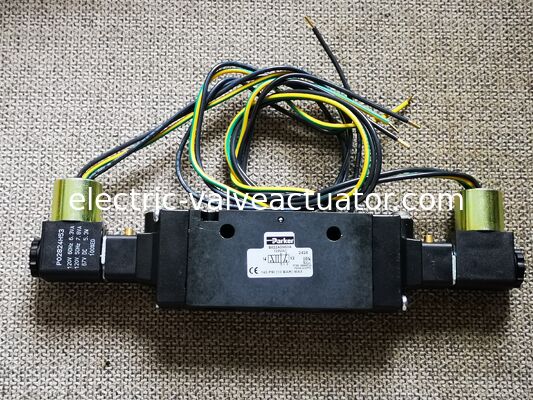
Parker B622ADH53A Solenoid Valve | Industrial Valve for Fluid Control
The Parker B622ADH53A Solenoid Valve is an industrial fluid control component designed to support reliable switching operations across automated machinery and process systems. As an electrically actuated valve, it provides a practical way to coordinate fluid movement with the control logic of industrial equipment, helping create responsive and organized operating sequences.
Fluid management is an essential part of many industrial processes. Whether a system relies on pneumatic control, automated machinery, process equipment, or specialized fluid circuits, the ability to direct and interrupt media at the appropriate moment can significantly influence overall system performance. A dependable solenoid valve provides the connection between electrical commands and physical fluid movement, allowing automated equipment to perform predefined functions with greater consistency.
Reliable Switching for Industrial Systems
The Parker B622ADH53A is designed to perform controlled valve operations in response to electrical control signals. This makes it particularly useful in systems where fluid movement needs to be synchronized with sensors, controllers, switches, actuators, or other automation components.
Instead of relying on manual valve operation, automated solenoid control allows fluid circuits to become part of a machine's programmed sequence. This helps simplify equipment operation while supporting repeatable performance in applications where frequent switching is required.
Its role can be especially valuable in machinery that performs multiple actions in a defined order. By coordinating fluid flow with the wider control system, the valve contributes to smoother transitions between different stages of an automated process.
Designed for Fluid Control Applications
The B622ADH53A can be incorporated into various industrial fluid-control architectures. Its application extends across pneumatic equipment, production machinery, process systems, material handling equipment, automated tooling, and other industrial installations where controlled fluid movement is required.
Within these systems, a solenoid valve helps manage the operation of connected components such as cylinders, actuators, control circuits, and other fluid-powered devices. Electrical signals from the automation system initiate valve action, allowing connected equipment to respond as part of a coordinated sequence.
This makes solenoid valve technology particularly useful for manufacturers and system integrators seeking to reduce manual intervention and improve process coordination.
Supporting Automation and Equipment Integration
Modern industrial machinery increasingly depends on communication between electrical control systems and mechanical processes. The Parker B622ADH53A serves as one of the functional links within this relationship.
When integrated into an automation architecture, the valve works alongside programmable controllers, sensors, switches, and monitoring equipment. The resulting system can respond to changing operating conditions while maintaining a structured control sequence.
For equipment designers, this provides flexibility when developing automated machines. For maintenance teams, a dedicated electrically controlled valve makes fluid-control functions easier to identify and integrate into troubleshooting procedures.
Suitable for Industrial Environments
Industrial components must operate as part of larger systems where reliability, repeatability, and practical integration are important considerations. The Parker B622ADH53A Solenoid Valve is intended for applications where controlled fluid switching forms part of everyday equipment operation.
Its industrial application makes it suitable for production environments where automated fluid management contributes to machine productivity. From individual equipment assemblies to larger process-control systems, the valve becomes an important part of a structured fluid-control solution.
Improving Process Coordination
A solenoid valve does more than regulate a fluid pathway. Within an automated machine, its operation influences the timing and movement of multiple connected components. Properly coordinated valve action helps actuators respond at the intended stage of a process, supporting consistent machine behavior.
This is particularly useful in applications where repeatable sequences are essential. Automated switching helps reduce unnecessary manual actions, improve workflow consistency, and contribute to more efficient equipment operation.
A Practical Parker Solution for Fluid Management
The Parker B622ADH53A Solenoid Valve offers a dependable approach to electrically controlled fluid management in industrial applications. By linking automation signals with physical valve operation, it helps equipment designers create more coordinated and responsive systems.
For industrial manufacturers, automation engineers, system integrators, and maintenance professionals, the valve serves as a valuable component within pneumatic and fluid-control assemblies. Its application across automated machinery and process equipment makes it a practical choice for systems that require organized switching and dependable fluid management.
Whether used in new equipment development, automation upgrades, or industrial maintenance projects, the Parker B622ADH53A contributes to a more structured approach to fluid control, helping modern machinery operate with greater coordination and efficiency.